For many organizations, the phrase “we need an interface” immediately starts an expensive conversation.
The assumption is often that a certified integration partner, proprietary middleware, or a vendor-supplied interface template is required. While those are certainly valid approaches, and often the right choice, they aren’t the only option.
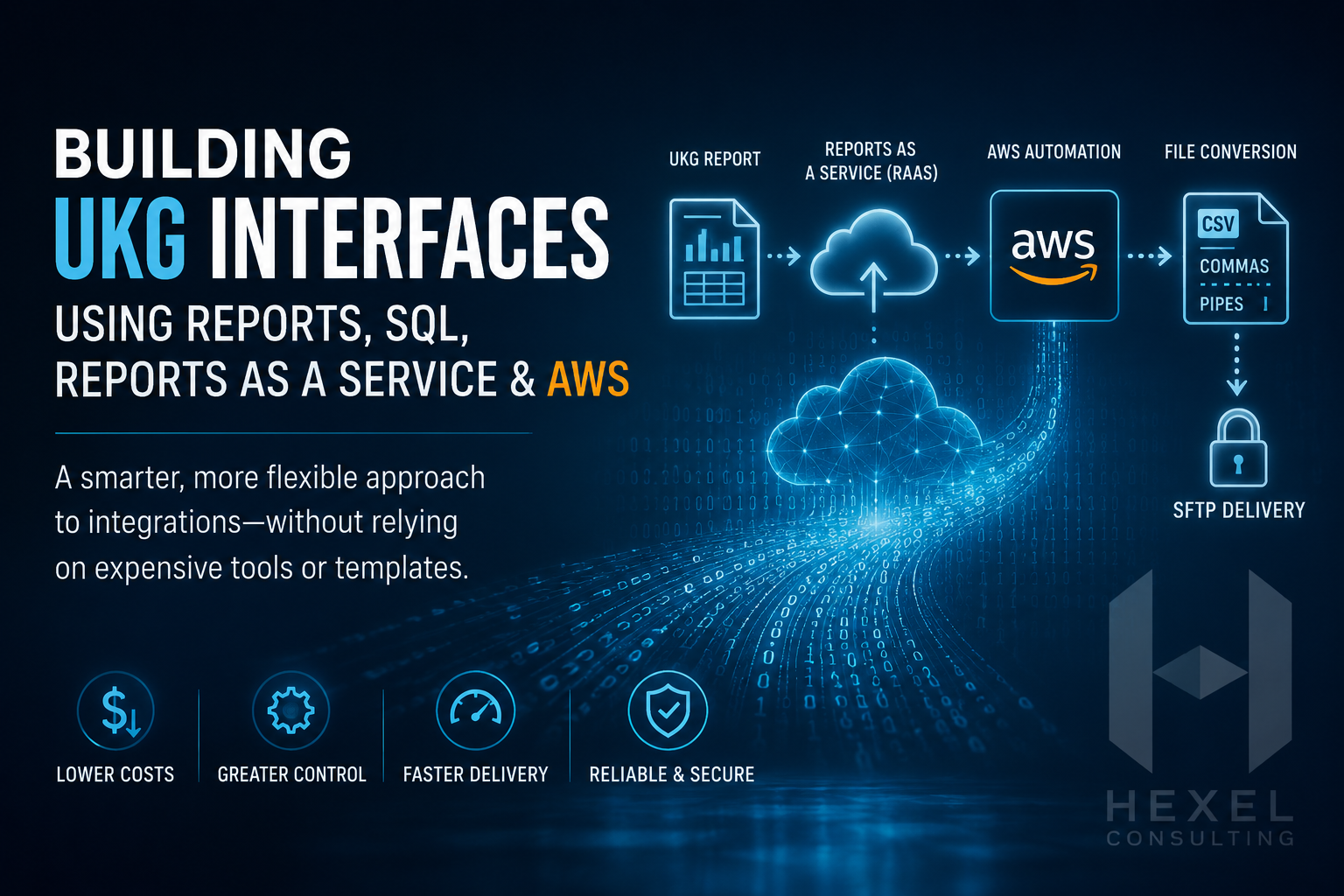
Recently, we helped a client implement an automated benefits enrollment interface using nothing more than a carefully designed UKG report, SQL, Reports as a Service (RaaS), and a lightweight AWS automation. The project demonstrated that many outbound interfaces can be built with tools organizations already own, giving them greater flexibility while significantly reducing implementation costs.
The goal of this article isn’t to argue against traditional integration approaches. Instead, it’s to help business and HR leaders understand that there are multiple ways to solve the same problem.
The Business Challenge
The client needed to deliver employee and dependent benefit enrollment information to an external benefits provider.
The vendor required:
- A scheduled outbound file
- Specific field mappings
- Pipe-delimited formatting
- Secure delivery to an SFTP server
- Reliable automated execution
This is a very common integration scenario.
Traditionally, many organizations would hire an implementation partner, get on UKG’s waiting list, and have the vendor build and maintain the integration. Those approaches can work well, particularly for organizations that prefer vendor-managed solutions or have highly complex integration requirements, but when you can take advantage of a full file export, you can be up and running in as little as 40 hours, and best of all, the solution is totally under your control, which keeps cost of ownership at a minimum.
Starting with the Data
Rather than building a custom application, we began by asking a simple question:
Can the reporting platform already produce everything the vendor needs?
In this case, the answer was yes.
Using SQL and UKG’s reporting capabilities, we created a report that contained:
- Employee demographic information
- Employment information
- Benefit elections
- Coverage levels
- Dependent information
- Vendor-required codes
- Business rules and calculated fields
Instead of writing application code to transform the data later, much of the business logic was embedded directly within the report itself. The report becomes the interface.
Reports as a Service (RaaS)
Many organizations think of reports as something a user manually runs from a browser and People Analytics as purely an analytical tool, but when you understand that Cognos is just a SQL generation tool, you can export text and XML. So rather than generating a PDF or Excel document for someone to read, a report can become a machine-readable data source that another system retrieves automatically.
That means the report isn’t simply reporting information. It’s publishing data.
For organizations already comfortable building reports, this can dramatically reduce the complexity of outbound integrations.
Where AWS Fits
Once the report was available through Reports as a Service, AWS handled the automation and formatting conversion.
The process was intentionally lightweight.
- A scheduled AWS job executed on a defined schedule.
- AWS connected to the report endpoint.
- The report output was downloaded.
- The comma-delimited file was converted into the pipe-delimited format required by the vendor.
- The completed file was securely transferred to the vendor’s SFTP server.
- Logging and error handling provided visibility into each execution.
The AWS component didn’t need to understand HR data or benefits rules. Its responsibility was simply to orchestrate the process, perform a small transformation, and deliver the file securely.
This separation of responsibilities made the overall solution easier to understand and maintain.
Why This Approach Can Be Powerful
One of the biggest advantages of report-driven interfaces is that the business logic stays close to the data.
When HR needs to add a field, modify a calculation, or adjust eligibility rules, the work often happens in the report instead of requiring changes throughout a larger integration platform.
That doesn’t mean this approach is always simpler—but it can be significantly easier for organizations that already have strong reporting expertise.
Additional benefits include:
- Lower implementation costs
- Fewer moving parts
- Easier troubleshooting
- Greater transparency into how the file is produced
- Reduced dependence on proprietary integration tools
- Faster delivery for straightforward outbound interfaces
It’s Not an Either/Or Decision
There are excellent reasons to use vendor-built interfaces, middleware platforms, or certified integration partners.
They often provide:
- Standardized support
- Prebuilt templates
- Complex orchestration
- Bidirectional integrations
- Monitoring dashboards
- Vendor maintenance
For large enterprise ecosystems with dozens or hundreds of integrations, those capabilities may justify the investment. However, not every interface requires that level of complexity. Many outbound files are simply well-structured extracts with business rules applied. In those situations, organizations should know that they have options.
The Bigger Lesson
One of the most valuable things experienced consultants bring to a project isn’t just technical knowledge, it’s perspective. Instead of immediately asking, “Which integration platform should we buy?” it’s often worth asking a different question:
“Can we solve this using capabilities we already own?”
Reporting platforms have evolved far beyond static reports. Combined with SQL, cloud automation, and secure file transfer, they can become reliable integration engines for many business processes. The result is a solution that’s easier to understand, less expensive to maintain, and fully controlled by the organization rather than hidden inside proprietary tooling.
Technology decisions shouldn’t be driven by habit.
They should be driven by the simplest solution that reliably meets the business need.